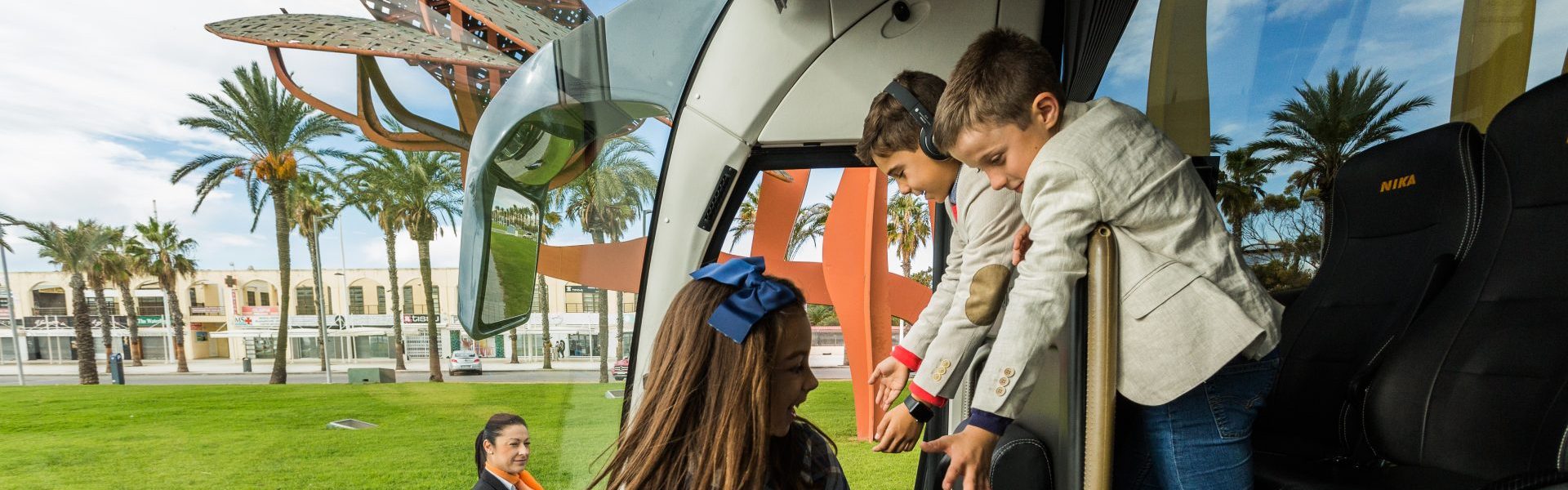
Every morning, thousands of children get on a bus to go to school. It seems simple: a vehicle picks up the students and takes them to their destination. However, behind every school route there is a great deal of work, safety measures, planning and technology that most families never see.
There is an aspect of school transportation that often goes unnoticed and that directly affects the peace of mind of parents, students and educational centres. In specialised companies such as Autocares NIKA, school transportation is not just about taking students from one place to another. Behind every route there is detailed planning aimed at ensuring safety, punctuality and comfort for students.
Safety, the most important aspect
When we talk about school transportation, safety is the most important factor.
Vehicles used for this service must meet specific requirements and undergo regular inspections to ensure they are in perfect condition.
In addition, drivers receive specialised training and have the necessary experience to transport minors safely.
Some of the elements that help improve safety include:
- Seat belts on every seat.
- Preventive maintenance of the vehicles.
- Incident protocols.
- Active and passive safety systems.
- Specific insurance for passengers.
All of this helps reduce risks and provide a safe environment for students during their daily journeys.
The importance of punctuality
A good school transportation service must not only be safe, it must also be punctual. School schedules are very precise, and any delay can affect classroom functioning and family organisation.
For this reason, specialised companies carry out preliminary studies to design efficient routes, optimise journeys and minimise possible incidents.
Planning is key to ensuring that students arrive at school on time and return home without unnecessary delays.
How are school routes designed?
Each educational centre has different needs. The school’s location, the number of students, pick‑up points and usual traffic conditions all influence service planning.
For this reason, school routes are usually designed in a personalised way.
This process allows companies to:
- Reduce travel times.
- Improve student comfort.
- Optimise vehicle use.
- Adapt to schedule changes or school calendar adjustments.
Good planning benefits students, educational centres and families alike.
Technology applied to school transportation
Technology has become a great ally in improving the management of school transportation. Today, many companies incorporate systems that allow them to control routes and improve communication with educational centres.
Among the most commonly used tools are:
- GPS systems: They allow real‑time tracking of the vehicle’s location and more precise route monitoring.
- Route control: Helps detect incidents, optimise journeys and ensure schedules are met.
- Immediate communication: Facilitates coordination between the transport company and the school in case of any incident.
Thanks to these tools, service management becomes more efficient and offers greater peace of mind to everyone involved.
Sustainable school transportation: an increasingly important trend
Sustainability is becoming increasingly important in mobility. Schools, families and companies are more aware of the need to reduce the environmental impact of daily travel.
In this context, collective transport offers significant advantages over the massive use of private vehicles. When several students use the same bus, the number of cars accessing the school area decreases, reducing congestion and emissions associated with traffic.
For this reason, companies such as Autocares NIKA are committed to progressively renewing their fleet and incorporating ECO‑label vehicles, contributing to more environmentally responsible school mobility.
The role of drivers
The driver plays a fundamental role in school transportation. Beyond driving, these professionals are responsible for ensuring students’ well‑being throughout the journey.
For this reason, they receive specific training in:
- Road safety.
- Child supervision.
- Incident management.
- Efficient driving.
- Customer service.
Their experience and professionalism are key to providing a high‑quality service.
In this context, at Autocares NIKA we work every day to offer mobility solutions that combine safety, efficiency, sustainability and adaptation to the needs of each educational centre.
Digitalisation, route optimisation and the incorporation of more sustainable vehicles will shape the future of the sector.
The goal will remain the same: to offer safe, efficient transportation adapted to the needs of students, families and educational centres.
Because behind every school bus there is much more than a simple journey. There is planning, technology, sustainability and, above all, a daily commitment to the safety of those who matter most: the students.


